(Updated as of 2025)
BREATHE + PAUSE + PONDER
Sabbathing Rhythms isn’t to be done alone. As the African saying goes, “It takes a village.” The sacred realities of these “rest rhythms” show up in our earthly living, both individually and within community. The many expressions of rest will address what’s happening internally (our being) and externally (our doing), our being + our doing are earnestly in a dance with others.
SOULjourner,
I’m delighted you’re here to explore your cyclical femininity through Sabbathing Rhythms—a gentle, rhythmic framework for peace, pause, and purpose. As an autistic mother of eight neurodivergent children, I know firsthand that every soul’s journey with rest is unique, cyclical, and dynamic.
Although I can’t provide a specific vision of how this will look for you personally, I assure you that I can offer my testimony + ideas from my thirty years of practicing: you’ll develop your own Sabbathing Rhythms recipe in a way that’s uniquely yours.
There isn’t a set formula—just an invitation to notice, nurture, and embody the alternation between your distinctive work-play + rest rhythms. It already exists, but we get to amplify it + attune it—that’s the beautiful liberation in this embodied, co-witnessing journey.
Being a firstborn, a mother of several children, and a creative, I’ve always felt the urge to get things done. However, with each passing season, I’m softening + nurturing not only my responsibilities but also the sacredness of my expansive rest rhythms.
It’s crucial to recognize that a woman who doubts her own rhythms isn’t at fault; she’s confronting an ableist, systemic productivity narrative that she must actively disrupt. This understanding can serve as a nourishing reminder on the journey to reclaim time, align responsibilities + prioritize rest.
Responsibilities are to flow from our rest, not the other way around. Furthermore, rest is not a reward or a by-product of a burnout trauma response; rather, it’s a gift from God and a testament to our worth we get to embody in our lives. By nurturing our rest, we allow our work-play + responsibilities to emerge from a place of audacious, scrappy, sensual soul care.
As the gardeners of our lives, we get to cultivate sustainable practices that comprehensively tend to—body, brain, and spirit (guilt-free, shame-free). My delight is to help you elevate your daily living into an art form, rooted in your cyclical, feminine rhythms.
Sabbathing Rhythms aren’t merely about discipline; instead, they encourage a devotion—to self-compassion, honesty, curiosity, and a growing hospitality toward your holy humanity.
And I’m not talking about a devotion rooted in a zero-sum mentality, where one person’s gain feels like another’s loss. Generative devotion allows for abundance + interconnectedness, embracing the idea that nurturing oneself creates space for others to flourish as well.
Sabbathing Rhythms are about devotion, not discipline.
When we are devoted, discipline shows up on its own. Our rhythms aren’t rigid schedules—they’re living currents that flow with each season of life, every phase of the month/moon, and even the rise + fall of a single day.
Imagine a Monstera leaf. It doesn’t force itself to be something else; it simply opens when the light is right and folds when shade falls. Its strength comes from the roots—moments of rest + replenishment that feed the whole plant.
What that looks like for us:
- Root‑level rest – carve out short, intentional pauses (breath, stretch, a sip of water). These are the hidden nutrients that sustain you.
- Leaf‑level movement – let your actions expand naturally when conditions feel right—whether that’s a burst of creative work, a nurturing conversation, or a focused task.
- Adapt, don’t change – like the Monstera, you stay true to yourself; you only adjust how you relate to the environment around you.
When we dare to honor a rest‑to‑replenish approach, we allow our “leaves” to unfurl when the moment calls, discipline becomes a gentle by‑product—not a forced rule. This makes for peace, not productivity.
You are invited to explore, experiment, and expand, making space for your unique journey, especially as you navigate your own neurology with your village: community of family, friends, neighbors, etc.
Let’s pause + dig into the roots of Sabbath—a word with layers of meaning, both ancient + new.
Sabbath: A Mini-Lesson in Meaning + Etymology
The word Sabbath is rooted in the Hebrew term Shabbat, which means “to cease, to rest, to celebrate, to bring to completion.” Sabbath is more than simply pausing from work; it’s a noble redirection of our energy + attention. The word embraces both “ceasing” + “celebrating,” revealing its true essence: not just the absence of work, but the presence of delight.
In Genesis, the Divine “rested” not out of exhaustion, but as an act of celebration, completion, and delight, honoring wholeness (completeness).
This wholeness perspective calls for a transition from a linear to a cyclical view, from either/or to an integrative both/and approach—from shame to Sankofa—a reclaiming of inheritance that invites us HOME to our sacred and sensual SOULbriety.
Rest, then, is not a reward for productivity, but an inherent birthright—a rhythm woven into the fabric of creation itself. It’s meant to be a sensory sanctuary.
Sabbath is about relationship, not a rule to be rigidly followed, but a rhythm to be savored. It’s a reminder that we are whole and we are more than what we produce. It’s an act of resistance against the grind, and a gentle homecoming to abundance.
I’m not going to sit here and act like this is easy—not for one moment is this easy to cultivate—but it’s worth it to tend to this life garden experience. We’re not aiming for perfection or complicated practices, but for alignment, simplicity, and connection.
Sabbathing Rhythms welcome you to make them your own. They are not prescriptive or formulaic, but an invitation to honor your body, your story, and your season. You are free to redefine what peace, nurture, and rest look like for you, and to return, again and again—to the sacred art of being fully, tenderly human.
Sabbathing is an attitude of the heart that celebrates, rather than a series of actions. Even when we don’t feel like celebrating or when life seems chaotic, Sabbath calls us to pause + dare to find rest in the rhythm of the Divine presence + communal provision.
It is a multifaceted rest that teaches our souls that celebratory rest is not limited by emotions or situations but arises from connection.
Rest is not One Size Fits All
Rest is not one-size-fits-all. Dr. Saundra Dalton-Smith identifies seven types of rest in her book Sacred Rest, reminding us that different dimensions of our wellbeing require different forms of RESToration:
- Physical rest: Wrapping up in your favorite blanket or cozy soaks, naps, gentle stretching, deep breathing exercises, slowly + gently washing your face, massaging your vagus nerve in your neck, walking, watching TV, soaking in a salt bath, taking a shower with a shower steamer or essential oil drops, softly rubbing moisturizer on your body. Even something as simple as sitting down with your feet up can be restorative.
- Mental rest: Meditation, mindfulness practices, stepping away from screens, cognitive breaks by paying attention to your senses, pausing information input, create a dream board or vision board, blowing bubbles, bird watching, or activities that don’t require decision-making.
- Emotional rest: Journaling (written or audio), processing feelings, and expressing emotions through conversation. Emotional rest can also include getting lost in a book, a playlist, movie, or game.
- Sensory rest: Reducing sensory input by creating calm environments, managing sensory sensitivities with tools like noise-canceling headphones, listening to soothing soundscapes, lying down with an eye mask, wearing soothing clothes, or sleeping with a weighted blanket.
- Creative rest: Engaging with art or nature through creative experiences like daydreaming, doodling, cooking, crocheting, or coloring—simply allowing your mind to wander freely. There’s no agenda for productivity.
- Social rest: Balancing social interactions through selective socializing or alone time. Social rest also involves spending time with people who replenish you + allow you to be fully yourself without needing to mask or pretend.
- Spiritual rest: Connecting with a sense of purpose through reflection on values; engaging in meaningful practices such as prayer, journaling, somatic movements, meditation, or spending time in nature to reconnect with God (Love).
We need more than one type of rest to truly restore our souls—and identifying what kind of rest you need and are worthy of can sometimes be tricky.
For neurodivergent souls especially,
- Developing a practice of attuning to yourself throughout the day or week is a compassionate response to your humanity. By checking in with how you’re rhythmically feeling—physically, emotionally, mentally—you can better discern what kind of rest your unique humanity needs + desires.
- There is a wisdom in taking frequent short breaks throughout the day—but for some neurodivergent individuals, this may not be possible or it can feel disruptive rather than restorative. Make sure you audaciously advocate at work or in the classroom for sensory breaks. If you thrive on long periods of uninterrupted work followed by substantial downtime instead of brief pauses—embrace it, SOULjourner.
- Frustration with having support as a grown Black woman is the common narrative + major challenge. Nevertheless, we ask, and keep asking as an expression of rest for the accommodations that help us to expand our rest. In doing so, we experience rest as an embodied freedom cry + outcome.
- Our rest rhythms will look different + diverge not only from others’ but also from previous ways we may have engaged rest. And how we perceive + define rest. I perceive it as a birthright, and I define rest as the noble redirection of my energy + attention. I like to also think of rest as a reservoir rather than a swamp.
A reservoir facilitates a dynamic input + output process, drawing energy from one source to replenish another effectively. You + your village contribute energy, thoughts, and emotions into this reservoir, allowing you to draw from it to replenish.
In contrast, a swamp can become stagnant, filled with murky waters where inputs don’t flow out, leading to decay rather than replenishment. Unlike a reservoir that refreshes and sustains, a swamp can diminish energy, ultimately hindering your ability to recover.
I can’t emphasize enough how essential a role your village plays in reservoir-living. Sometimes, it requires reorienting + reorganizing one’s life to increase the accessibility to supportive sabbathing rhythms.
Sabbathing Rhythms – Four Facets of Rest
Know Your Biological Rhythms
Biological rhythms are classified into circadian, infradian, and ultradian rhythms, based on their frequency.
Rhythms 101
Circadian Rhythms (around 24 hours)
Definition: Circadian rhythms last approximately 24 hours. The most well-known example is the sleep/wake cycle.
Examples:
Sleep/Wake Cycle: This rhythm dictates periods of alertness + sleep, regulated by light exposure + the body’s internal clock.
Body Temperature: Body temperature fluctuates over 24 hours, peaking in the afternoon and dropping during the early hours of the morning, promoting sleep.
Research: Studies show that circadian rhythms persist even without external cues, though they tend to shift slightly from 24 hours, demonstrating the role of internal clocks.
Infradian Rhythms (longer than 24 hours)
Definition: Infradian rhythms are cycles that last longer than 24 hours and often occur on a weekly, monthly, or seasonal basis.
Examples:
Menstrual Cycle: Lasts about 28 days, regulated by hormonal changes + sometimes influenced by external factors.
Seasonal Affective Disorder (SAD): A yearly rhythm related to changes in light exposure during winter months, affecting mood + energy levels.
Ultradian Rhythms (less than 24 hours)
Definition: Ultradian rhythms are shorter cycles that occur more than once within 24 hours.
Examples:
Stages of Sleep: The sleep cycle consists of different stages (e.g., stages 1-4 and REM) that repeat approximately every 90 minutes throughout the night.
Basic Rest-Activity Cycle (BRAC): Involves 90-minute cycles of alertness and fatigue during waking hours, as proposed by Kleitman.
Research: Studies of the sleep cycle demonstrate how we move between stages of light and deep sleep, showing a natural ultradian rhythm in sleep architecture.
But for our purpose with Sabbathing Rhythms, we’ll focus on two of these biological rhythms. These rhythms are organized in four facets and rooted in: our solar rhythm (circadian rhythm) and our lunar rhythm (infradian rhythm).
Get the free Sabbathing Rhythms toolkit guide:
- Daily Diversions + Decisions
- Weekly Withdrawals + Woo
- Monthly Moments + Meditation
- Annual Abandonments + Attunement
Daily Diversions + Decisions:
Small, intentional pauses woven into your everyday, like mindful breathing, pausing between activities to reset your mind + body, reduce stress, regulate emotions, and support self-compassion for the choices you make throughout the day. These micro-moments of care are your daily invitations to practice presence + nurture your nervous system amid interruptions.
Weekly Withdrawals + Woo:
Once a week, carve out a sabbatical day for deeper regenerative rituals that celebrate + center you. This is your time to withdraw from the demands of the world + woo your soul back to pleasures to replenish your emotional reserves.
Monthly Moments + Meditation:
Every month, set aside moments to look back on the passing month + the month to come. This monthly check-in ritual invites you to reflect + reset (you can refer to your calendar, journaling entries, voice memos, text messages, emails, wherever you have documented how you showed up).
Annual Abandonments + Attunement:
Allow yourself once a year to completely step away from routine + attune with your desires by altering your surroundings, whether for a a few hours, a day, overnight, or a weekend. This yearly ritual is focused on auditing + savoring your life—past, present, and future—this does not need to be reserved for New Year’s.
Reflection + Last Thoughts
Before you seek to add new practices, pause to notice the Sabbathing Rhythms already woven into your life.
What rituals of rest + pleasure do you currently honor, even in small ways?
These everyday mini moments can add up.
Examples of Everyday Sabbathing Rhythms
1. Email Signature
Setting clear boundaries in your email signature gently communicates your commitment to rest: “I honor intentional rhythms of rest. I check emails three times a day: 10 am, 2 pm, and 7 pm on weekdays and pause correspondence during evenings and weekends for Sabbath rest.”
2. Notification-Free Times
Designate specific hours when notifications are silenced, perhaps after dinner or during early mornings, to create sacred space for renewal: “Notifications are off from 7 pm to 8 am to nurture family time + personal renewal.”
3. Rituals of Pleasure
Notice the small pleasures that already punctuate your days:
- Savoring a cup of water or tea ( or your favorite beverage) in the morning sun
- Taking a mindful walk after lunch
- Lighting a candle
4. Family or Community Practices
Swapping resources + sharing responsibilities, weekly movie nights, shared meals, or weekend afternoon naps can all be Sabbathing Rhythms that foster connection + bliss.
5. Spiritual or Creative Practices
Engaging in prayer, meditation, or a creative hobby (like sketching, puzzles, coloring, or gardening) as a regular, restorative ritual.
By noticing + cherishing these rhythms, you cultivate a spirit of Sabbathing—one that moves beyond simply adding more, inviting you instead to savor what already is + to reclaim your life from the weight of trauma and/or self-neglect.
Together, we embrace our divinely infused lives one small, aligned decision at a time.
May we personally + collectively… Rest. Reimagine. Reclaim. Respond.
You are invited to make Sabbathing Rhythms your own. There is no one right way, only your way, in your season, with your soul. And as a fellow SOULjourner, walking this neurodivergent, zig zag, creative path alongside ya, I’m cheering us on every step of the way.
journal your inner musings

Whether verbally or in written expression, document a communal affirmation:
Beginning with, “We are…”
Now do the same for a personal affirmation:
Beginning with, “I will…”
Two Gift Set SOULutions to Help You Rhythmically live Your Life
If you enjoy a kinder + gentler thirty-day streak of intention setting…
choose a not-so-typical 30-Day Intentions Journal-Planner style SOULution designed to support your intentional living + soul care journey.
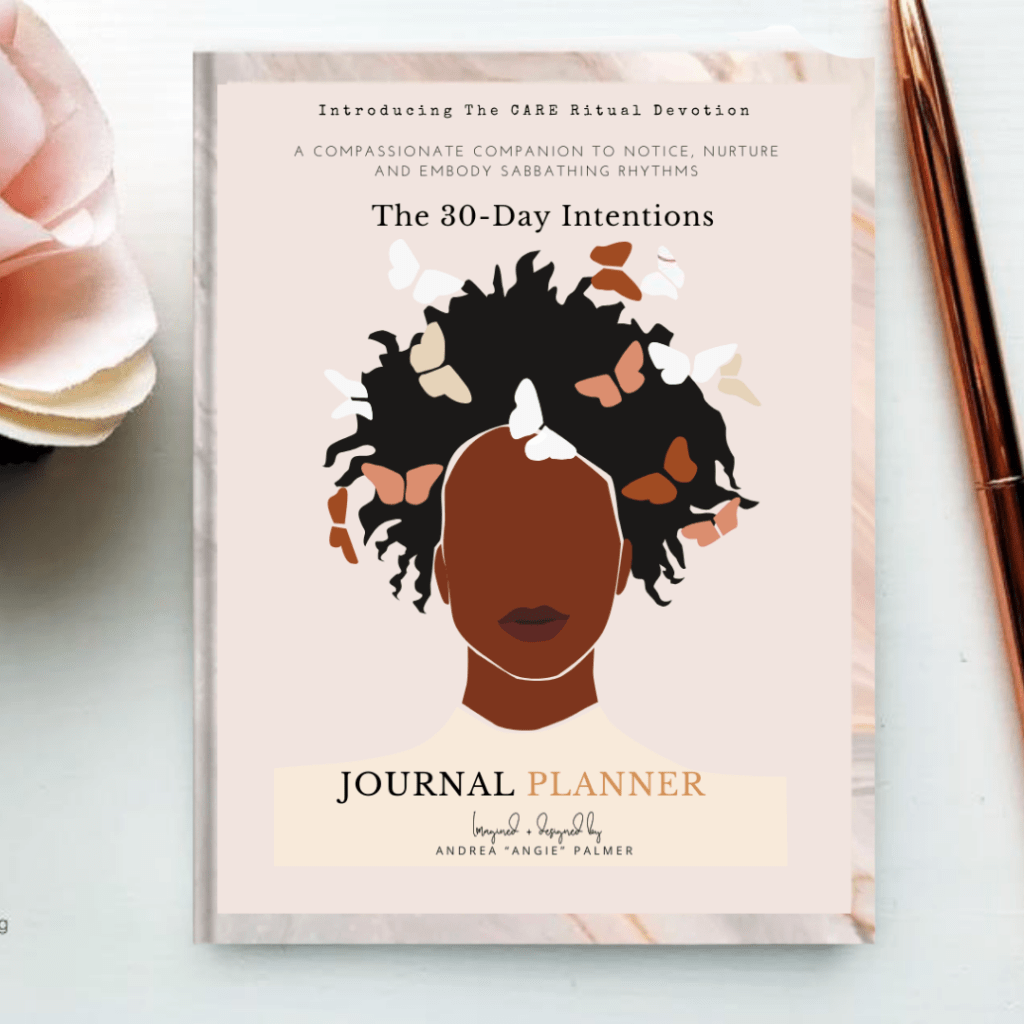
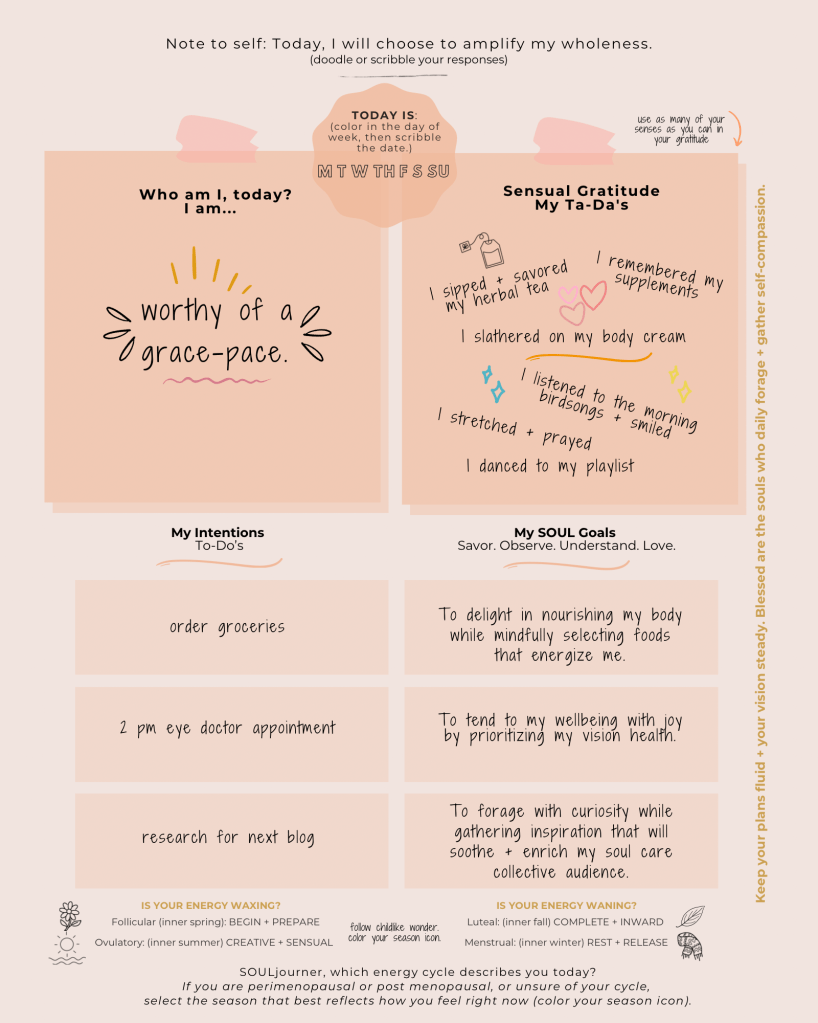
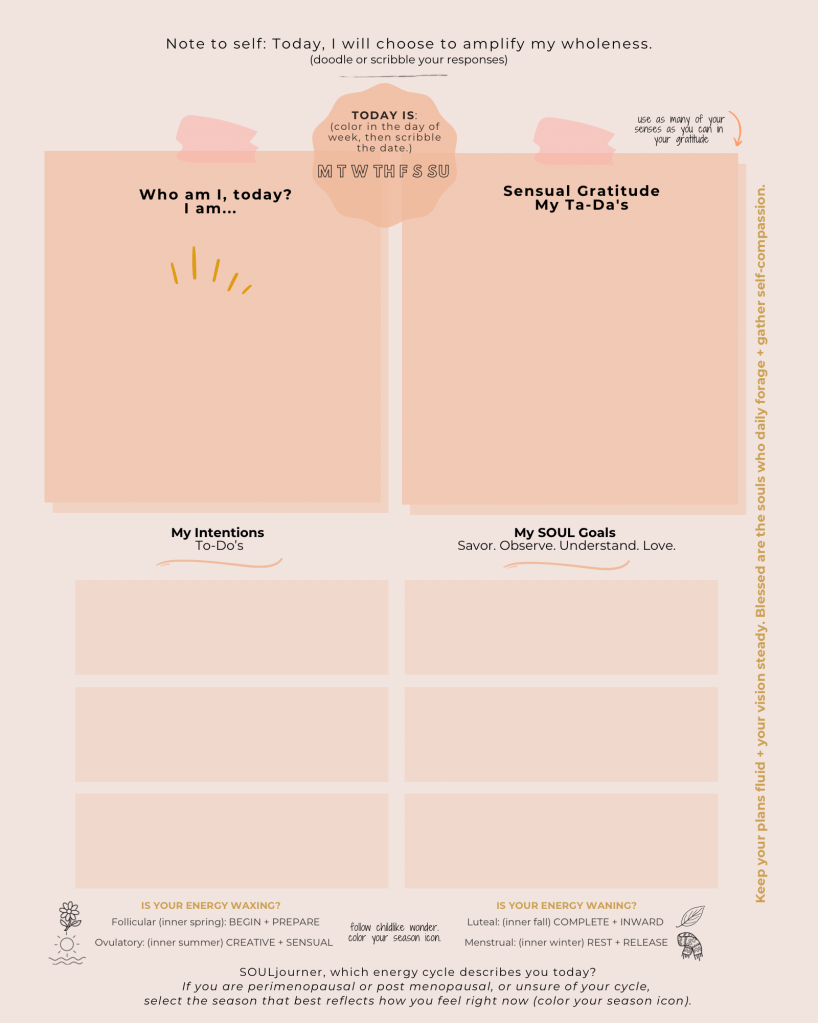
Unlike traditional annual planners that can feel rigid + overwhelming, my soul care approach offers a month-by-month journey that adapts to your unique flow.
If you enjoy a kinder + gentler day-to-day streak of intention setting…
choose the fun Note to Self Intentions Notepad style SOULution.
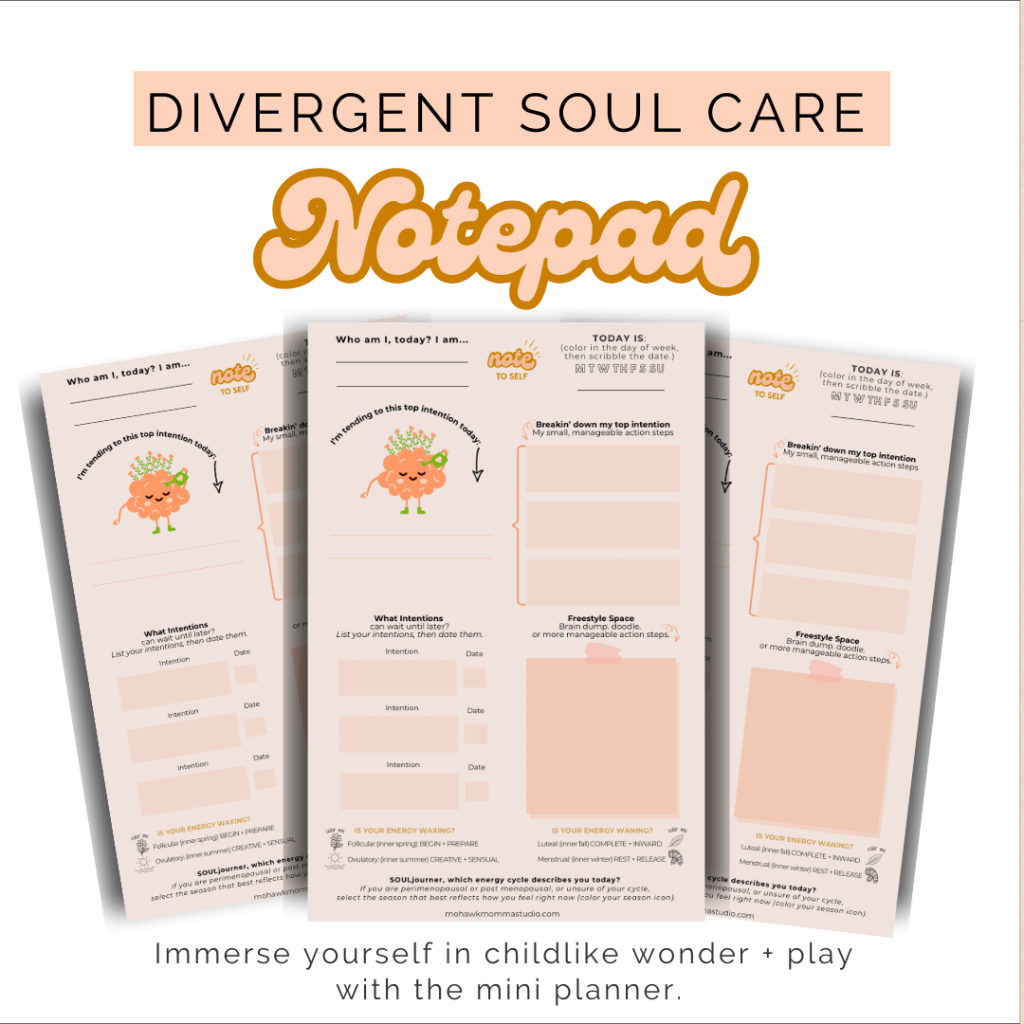
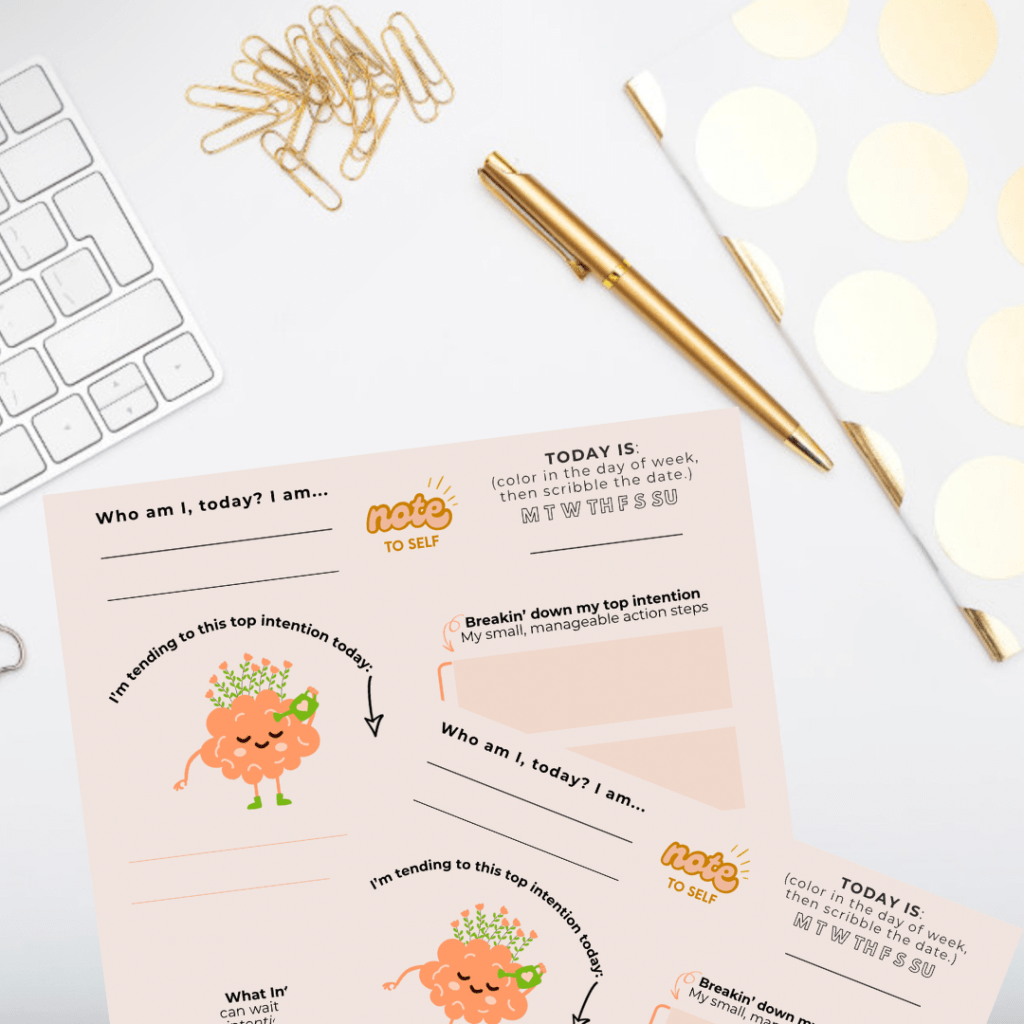
Beyond the overwhelm of endless to-do lists, nurture your daily flow with intentional action steps that honor your desires + dreams + your energy. This isn’t about checking boxes—it’s about creating space for your beautiful, unique self to breathe + do + be.
Soulful gifting for social change 🧡
Until next time,
Gift from your soul.
Deepen Your Soul Care Journey
Beloved SOULjourner, as you continue to nurture your gift-giving practice, discover sustainable gifts designed to embody intentional gift-giving + connection.
Soulful gifting for social change in the soul care boutique. Be inspired to amplify your ARTvocacy through peace + play vibes.
Disclaimer: This blog post is for informational purposes only as I share my pastoral care, my journey, and bring to you valuable research. It is not intended to be a substitute for professional medical advice, diagnosis, or treatment. If you are experiencing any medical concerns or symptoms, please seek the guidance of a qualified healthcare professional.
JOIN THE SOULJOURNER COLLECTIVE
Receive soul care wisdom + exclusive meditative peace practices in your inbox. Enter your name + email to join our global community of intentional gift-givers.

 Soulful Giving and Living
Leave a comment